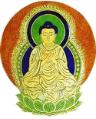
Higan (彼岸) is a Buddhist holiday celebrated in Japan
during both the Spring and Autumnal Equinox. It is
observed by nearly every Buddhist sect in Japan. The
tradition extends from mild weather that occurs during
the time of equinoxes, though the origin of the holiday
dates from Emperor Shomu in the 8th century.
People who normally worked in the fields had more
leisure time to evaluate their own practices, and to
make a renewed effort to follow Buddhism. Today,
special services are usually observed in Japanese
Buddhist temples, and Japanese temples abroad,
based on the particular Buddhist tradition or sect.
The etymology of higan means "The Other Shore",
which is a common euphemism used in Buddhist
literature to refer to Enlightenment. One crosses from
this shore of ignorance and suffering to the other shore
of Enlightenment and peace. In the Alagaddupama
Sutta of the Pali Canon the Buddha uses a simile of a
person constructing a raft to cross one shore to the
other, symbolizing realization or Enlightenment. In the
Heart Sutra of Mahayana Buddhism is the mantra
(Definition from http://en.wikipedia.org/wiki/Higan)
during both the Spring and Autumnal Equinox. It is
observed by nearly every Buddhist sect in Japan. The
tradition extends from mild weather that occurs during
the time of equinoxes, though the origin of the holiday
dates from Emperor Shomu in the 8th century.
People who normally worked in the fields had more
leisure time to evaluate their own practices, and to
make a renewed effort to follow Buddhism. Today,
special services are usually observed in Japanese
Buddhist temples, and Japanese temples abroad,
based on the particular Buddhist tradition or sect.
The etymology of higan means "The Other Shore",
which is a common euphemism used in Buddhist
literature to refer to Enlightenment. One crosses from
this shore of ignorance and suffering to the other shore
of Enlightenment and peace. In the Alagaddupama
Sutta of the Pali Canon the Buddha uses a simile of a
person constructing a raft to cross one shore to the
other, symbolizing realization or Enlightenment. In the
Heart Sutra of Mahayana Buddhism is the mantra
(Definition from http://en.wikipedia.org/wiki/Higan)
Major Service
HIGAN FALL
SHINRAN SHONIN MEMORIAL
HIGAN FALL
SHINRAN SHONIN MEMORIAL