2010 JUNE
HOW TERRIBLE THE THREE POISONS ARE!
HOW TERRIBLE THE THREE POISONS ARE!
Last month, my daughter had bronchitis. My family and I were staying at a hotel in Los Angeles the
day before the BCA Federation of Dharma School Teachers League Conference, when my daughter’
s health changed suddenly that night. She developed a terrible, wracking cough. Because lying down
made her uncomfortable, she wouldn’t stop crying unless she was held. We took turns holding her to
see if she might feel better, but after a few hours, she did not improve but rather went from bad to
worse.
Though it was already past two in the morning, we decided Mika and Kurumi would return to
San Diego. I was really worried about Mika because she hadn’t slept at all since the morning. But
because this was the best way to ensure our daughter would be able to see the doctor early the next
morning, I asked my wife to return home.
It took Mika two and a half hours to drive back to San Diego. She got no sleep at all that night.
She took our daughter to the hospital at 9:00 a.m. where Kurumi was diagnosed with bronchitis and
sent home with some medication. After two days of suffering through a bad cough and recurring fever
of 104 degrees, Kurumi got much better because my wife really took good care of her.
When I returned from the conference a few days later, Mika looked as if she had aged ten years
with all the anxiety and lack of sleep. After that, although I took over looking after our daughter, I really
sensed my wife’s love and worry, to be able to hold our toddler—20 months old and 28 lbs.—through
two nights even at the risk of her own health. Through this experience, I was struck again by the
magnitude of having a child and the gravity of our responsibility as parents. I would like to take this
opportunity to thank my wife who cared for our daughter so devotedly.
As you can imagine, if we are childless but wish to have a child, we stress over this. But if we
do have children, it means the heavy responsibility as parents brings even more to worry about.
There is a famous phrase about this in the Infinite Life Sutra which I would like to share with you:
“If they have land, they worry about the land. If they have a house, they worry about the
house. In the same way, they worry about...their domesticated animals, their men servants and
maids, their money and wealth, clothes and food and furnishings. Accumulating worries and
compounding sighs, they live in constant anxiety and fear.”
It is a teaching that, whether or not they are possessed of fortune, all people suffer the same
anxieties. Before marriage, I always felt lonely and suffered from solitude. And although I married a
beautiful person, sometimes when we argue, I feel that she is a nuisance and miss my bachelor life.
When we are single, we feel the pain of being alone. But once we marry, we face new problems
never before experienced and we suffer from them as well. The teaching is not that we should
carefully choose a way to live better, but that anxieties and suffering are ever present despite the way
we live.
Although the environment surrounding us has changed greatly in comparison to eras past,
human nature has not changed at all and we continue worrying and suffering. Then why do we worry
and suffer? It is because we all suffer from a serious illness of the mind.
There is a saying in the Notes on Once-Calling and Many-Calling written by Shinran Shonin:
“We foolish beings are full of ignorance and blind passions. Our desires are countless, and anger,
wrath, jealousy, and envy are constantly overwhelming. To the very last moment of life they do not
cease, disappear, or exhaust themselves.”
Blind passions are the workings of the mind which confuse people and make them worry and
suffer. They are the cause of human suffering. Although there are various blind passions, the
particularly terrible ones are called “Three Poisons”: greed, anger, and ignorance. These blind
passions always appear suddenly to disturb us, and make us lose stability, and make us suffer.
Of course, animals also are greedy, but it is because of their instinct to survive. When they
feel hunger, animals eat other animals; but once full, they are satisfied. Humans will take beyond what
is needed to sustain life. We display food in grocery stores where often it will go bad and be wasted.
Our appetite has no limit. We always want to eat something more delicious than before, or wear a
piece of clothing even more beautiful than the last. We always feel deprived of something and we
never feel that we have enough. This type of greed and way of living is called the way of the hungry
ghost.
And when we are cursed at or treated badly, we always get angry. Even on the road, if
something disturbs our driving rhythm—being tailgated by an impatient driver, or when the car ahead
is going too slowly, or when someone in the next lane suddenly swerves in front of us—we instantly
lose our temper. I think that we probably get really mad about something or at somebody at least
once a day. When we feel anger, it creates in us a hell of suffering. This is called the way of Ashura,
which are fearsome spirits fond of fighting.
Ignorance means foolish knowledge. When we are ruled by blind passion, we cannot see or
judge things correctly, so we tend to interpret reality in ways that are advantageous to us. Therefore,
the rain that comes when we need it becomes a welcome rain; but the rain that comes unexpectedly
is a hateful rain. The way of living in which a person can’t tell what’s what is called the way of the beast.
However we may live our lives, we always complain, get angry, suffer, and worry. It is
because we are wandering ceaselessly through about the six realms of Samsara, pulled by the blind
passions of the Three Poisons.
However, by encountering the teachings Amida Buddha, our true selves are brought out. We
realize the foolishness of our selfish lives and we can reflect deeply upon our foolishness. And
through the light of wisdom, our mind of greed, anger, and ignorance changes into the mind of
knowing enough, rejoicing, and seeing things as they are. Then we will be able to accept all causes
and conditions with the deepest feeling of gratitude. I believe that by leading with the workings of Amida
Buddha, the mind of gratitude for everything softens our blind passions and brings us the mind of
great peace, which allows us to transcend the life of suffering. The mind of gratitude for everything is
the Nembutsu, “Namo Amida Butsu.”
The Nembutsu is the teaching that leads us to the life that accepts all things with a feeling of
gratitude; that says that it is not natural to take everything for granted; that says it is a shame to see the
world only through our selfishness; and that says we must reflect deeply upon ourselves.
I sincerely hope that with the Nembutsu each of us will try to transcend the realm of Samsara,
and walk the path together toward the world of gratitude where we can accept everything and all
events, even if they cause our worries and suffering.
In Gassho,
Dharma Message
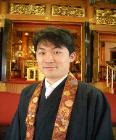
| By Rev. Yushi Mukojima, Resident Minister |